

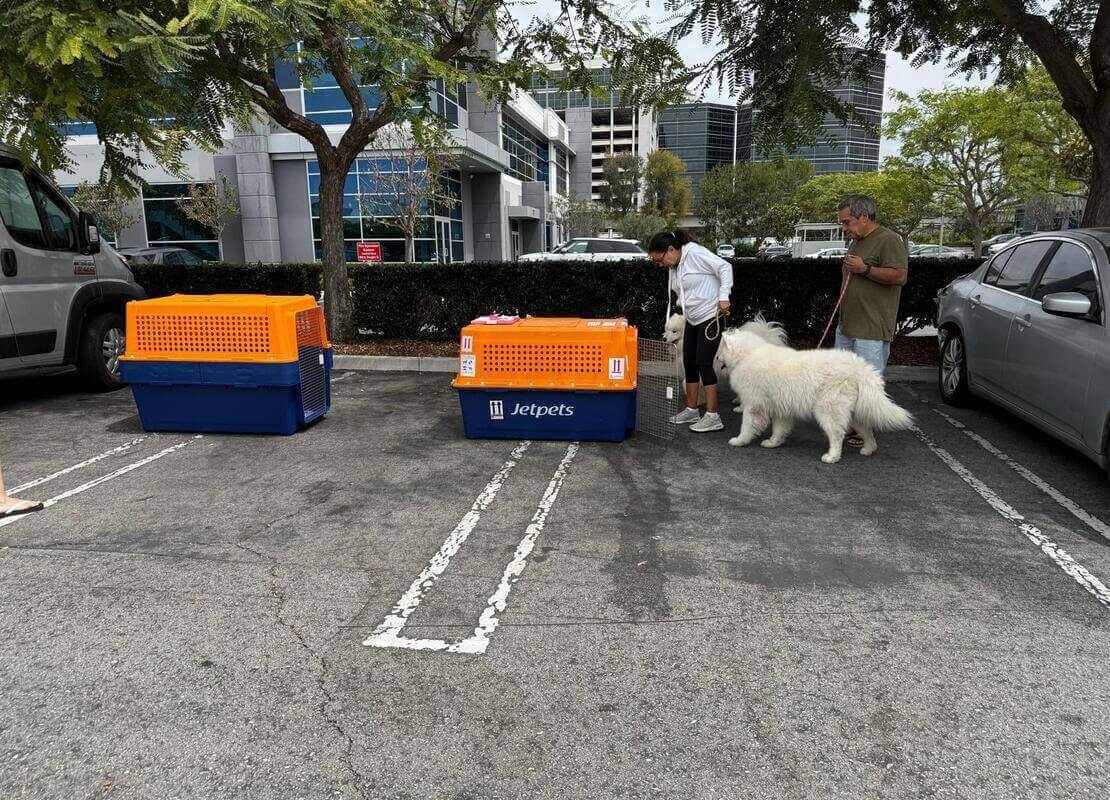
A crate that looks "close enough" can be the difference between a calm, comfortable flight and an airline refusing to board your dog at check-in. We recently completed an in-person crate fitting for two dogs, Aspen and Ava, ahead of their move to Spain — and what we found is a perfect example of why measuring on paper is never a substitute for fitting the actual dog into the actual crate before flight day.
Most international pet shipping problems that happen at the airport were actually decided weeks earlier, at home, with a tape measure. Crate sizing looks simple on paper — measure the dog, pick a crate size, done. But the line between "fits" and "doesn’t fit" is sometimes a single size designation, and getting it wrong means an airline can refuse to board your pet on travel day, no exceptions, no second chances at the gate.
That’s exactly what an in-person crate fitting is designed to catch. Paper measurements get you close. A physical fitting, with your dog actually standing inside the candidate crate, tells you whether "close" is actually "compliant."
Why In-Person Fitting Matters More Than the Tape Measure
Dogs aren’t uniform shapes. Two dogs with nearly identical body length can need different crate sizes because of how they carry their ears, how their elbows sit, or how their proportions shift the math right at the edge of a sizing bracket. A measurement that lands a few centimeters into "should be fine" territory on paper can turn out, the moment the dog actually stands inside the crate, to be a real problem — ears brushing the ceiling, head ducked slightly to clear the top.
This is precisely why our team does hands-on fittings ahead of travel day whenever possible, rather than relying on remote measurements alone. We bring multiple candidate crate sizes to the appointment, measure the dog standing tall, and then physically place the dog inside the crate to confirm the fit before anything gets booked or finalized.
A Real Example: Aspen and Ava’s Crate Fitting
We recently ran exactly this kind of fitting appointment for two dogs, Aspen and Ava, ahead of their international move to Spain. The appointment took place in a parking lot in El Segundo, California — a simple, practical meeting spot, which is often all an in-person fitting really requires.
Our team took full standing measurements for both dogs using the standard A/B/C/E measurement points — body length, elbow height, body width, and ear height for erect-eared dogs.
| Dog | A — Length | B — Elbow Height | C — Width | E — Ear Height |
|---|---|---|---|---|
| Aspen | 38″ | 13″ | 10″ | 32.5″ |
| Ava | 40″ | 13″ | 11″ | 33″ |
Based on those numbers, a PP90 crate looked like a reasonable starting point for Aspen — close to her measurements on paper. But this is exactly the scenario an in-person fitting exists to catch.
Doesn’t Pass
PP90
When Aspen stood fully upright inside the PP90, her ears touched the top of the crate. No headspace margin — a non-compliant fit under IATA standards, even though the paper measurements looked close.
Perfect Fit
PP100
Using the PP100’s extension kit to convert it up one size, Aspen stood completely upright with clear space above her ears. Comfortable, compliant, and ready for travel day.
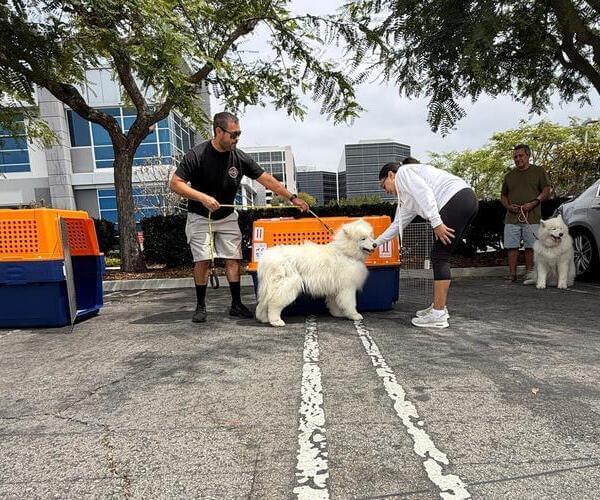
PP90: ears touching the top of the crate — not compliant.
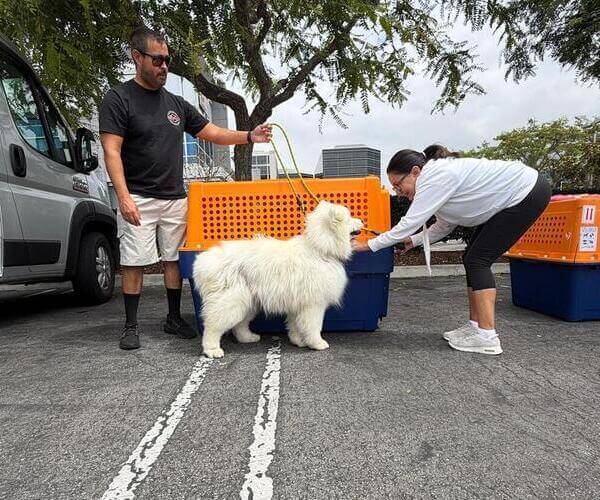
PP100 with extension: full headspace, ears clear, ready to fly.
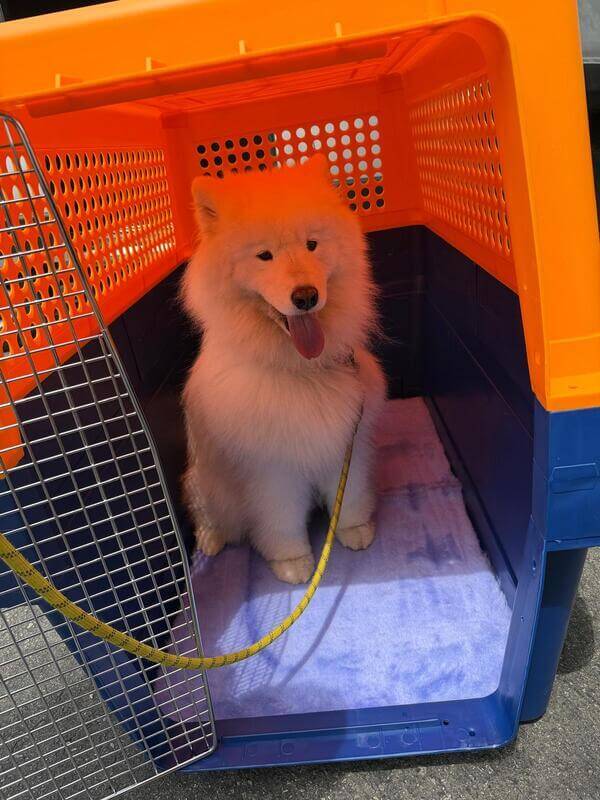
Seated inside the PP100: plenty of room to sit, turn, and settle in comfortably.
Not sure what crate size your dog needs?
Our team offers in-person crate fitting appointments to confirm the right size before you buy anything or book a flight.
How Crate Measuring Actually Works
Getting an accurate measurement starts with how the dog is positioned. According to our crate size guide, every measurement should be taken while the dog is standing tall — not sitting, not lying down — and measurements should never include hair length, only the body itself.
The Core Measurements
- A — LengthFrom nose to rump, while standing.
- B — Height to ElbowFrom the floor to the point of the elbow.
- C — WidthAt the widest point of the body, measuring flesh, not hair.
- D — Height to Top of HeadFrom the floor to the top of the head.
- E — Height to Ear Tip (Erect-Eared Dogs)For breeds with upright ears, like Aspen and Ava, this becomes the true top reference point — not the head.
That last point is exactly what made the difference in Aspen’s fitting. For dogs with erect ears, the ears — not the skull — are usually the tallest part of the standing dog. A crate sized only against head height can look correct on paper while still being too short in practice, which is exactly the gap an in-person fitting catches before it becomes a travel-day problem.
The 10cm Headspace Rule — And Why It’s Non-Negotiable
Per our crate guidelines, your dog needs at least 3 inches (about 10cm) of clearance above their head — or, for erect-eared breeds, above their ears — while standing fully upright inside the crate. This isn’t a suggestion; it’s the standard airlines check at the counter, and it’s the same standard our team measures against during every in-person fitting.
A few additional rules worth knowing:
- Brachycephalic (flat-faced) breeds — Bulldogs, Pugs, Boston Terriers, Persian cats — need one crate size larger than their raw measurements would suggest, due to their increased risk of respiratory stress during travel.
- Measure twice. A single measurement taken while a dog shifts its weight or doesn’t stand fully square can throw off a sizing decision. Our team always double-checks before finalizing a crate.
- Extension kits exist for exactly this reason. As Aspen’s fitting showed, a crate one size up — sometimes using a manufacturer extension kit rather than buying a fully different crate — can solve a borderline fit without overcomplicating the process.
Crate Sizing Resources
Planning your own pet’s crate before travel? These resources walk through the full process:
Don’t leave crate sizing to guesswork.
Schedule an in-person crate fitting with our team before your pet’s international move — the same hands-on process that caught the difference for Aspen.